Integrating social, emotional, and behavioral skills with learning frameworks

Two cross-sectional studies in high schools

Tommaso Feraco

University of Padova

Gerardo Pellegrino

University of Padova

Barbara Carretti

University of Padova

Chiara Meneghetti

University of Padova

Who is a successful student?

From a skill perspective

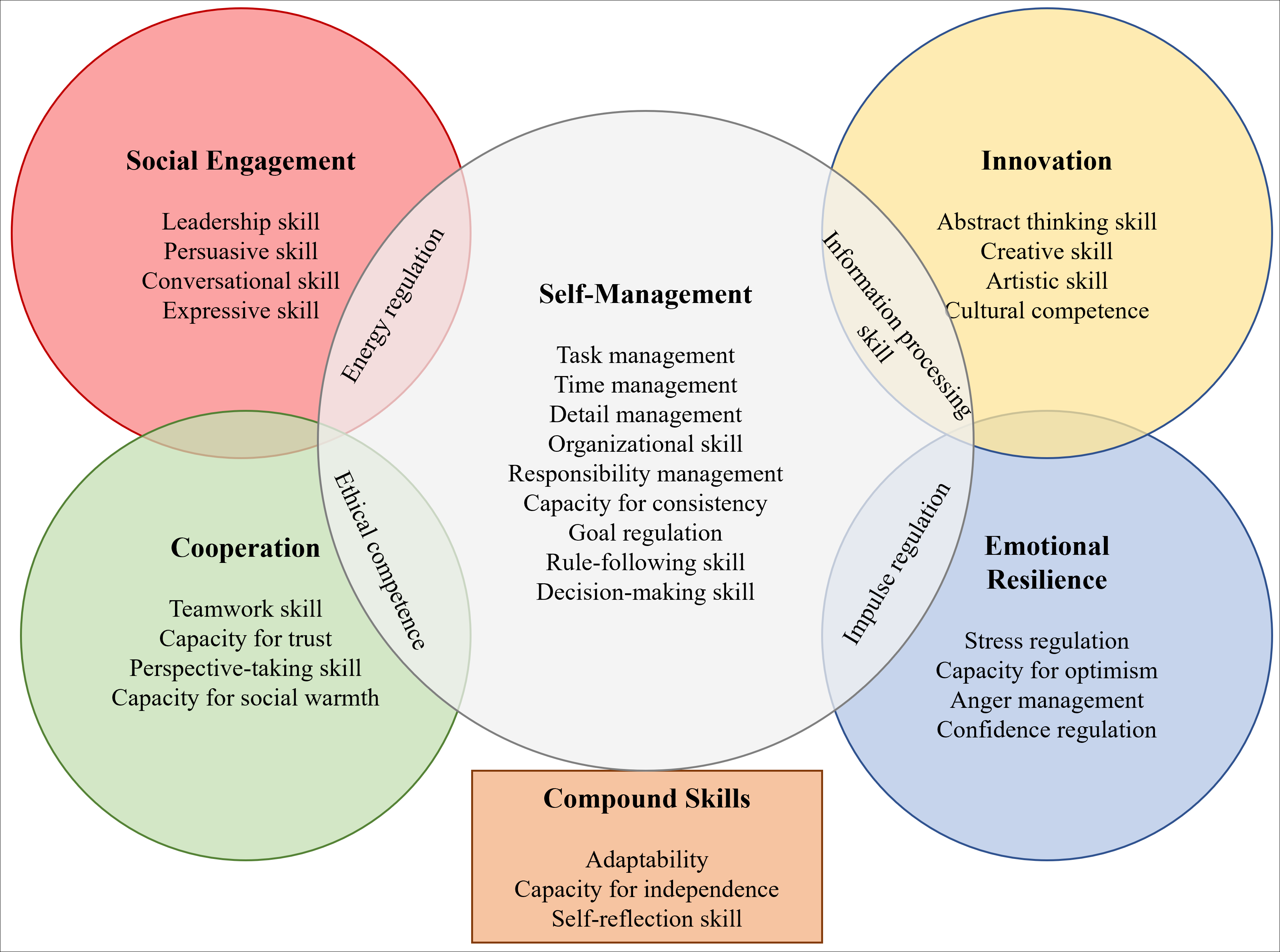
Social, emotional, and behavioral skills represent the abilities to establish and maintain social relationships, regulate emotions, and effectively manage behaviors toward goals and learning and mainly fall into five areas1:

  • Self-management skills
  • Social engagement skills
  • Cooperation skills
  • Innovation skills
  • Emotional resilience skills

These are linked to students’ academic achievement, school engagement, social relationships, and well-being24.

From an educational perspective

Learning is a complex activity and educational literature is maybe even more complex and vast. From this perspective, students need:

  • Cognitive abilities
  • Motivation
  • Beliefs
  • Study strategies
  • Emotions
  • Engagement

Merging the different perspectives

The two fields, however, remain largely separated and rarely integrated, but few proposals have been advanced:

  • The Integrative Development-in-Sociocultural-Context Model5

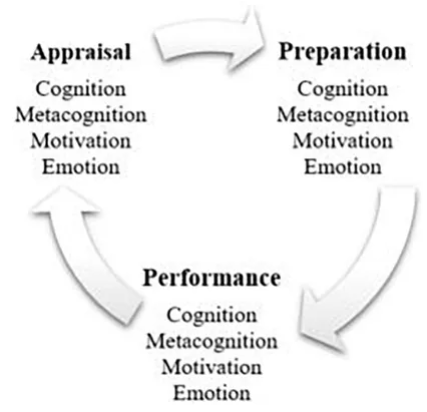
  • The integrated self-regulated learning model6

  • Social-emotional Competence School Model7

  • Social-Emotional Flourishing Framework Collie8

The studies

Main questions

  • Do SEB skills correlate with academic (and non-academic) outcomes in high school students, including SRL factors?
    • Study 1: emotional, motivational, and strategic factors
    • Study 2: school engagement
  • Do SEB skills predict academic (and non-academic) outcomes beyond SRL factors?
  • What are the main mechanisms linking SEB, SRL, and achievement?

Participants & materials

STUDY 1 Participants

  • 5075 students (18.23 yo [sd = .0.95])

Materials

  • SEB skills: BESSI-459
  • SRL factors:10
    • SRL strategies
    • Academic self-efficacy
    • Learning goals
    • Growth mindset
    • Achievement emotions
  • Life satisfaction scale11
  • Peer acceptance12
  • Academic achievement: average grades

STUDY 2 Participants

  • 1642 students (15.5 yo [sd = 1.47])

Materials

  • SEB skills: BESSI-459
  • School engagement13
  • School satisfaction14
  • Life satisfaction scale11
  • Burnout15
  • Fluid intelligence16
  • Academic achievement: average grades
Responses were screened for careless responding using multiple detection methods.

Study 1

Feraco, Bonelli, Da Re, & Meneghetti (2025) Social Psychology of Education

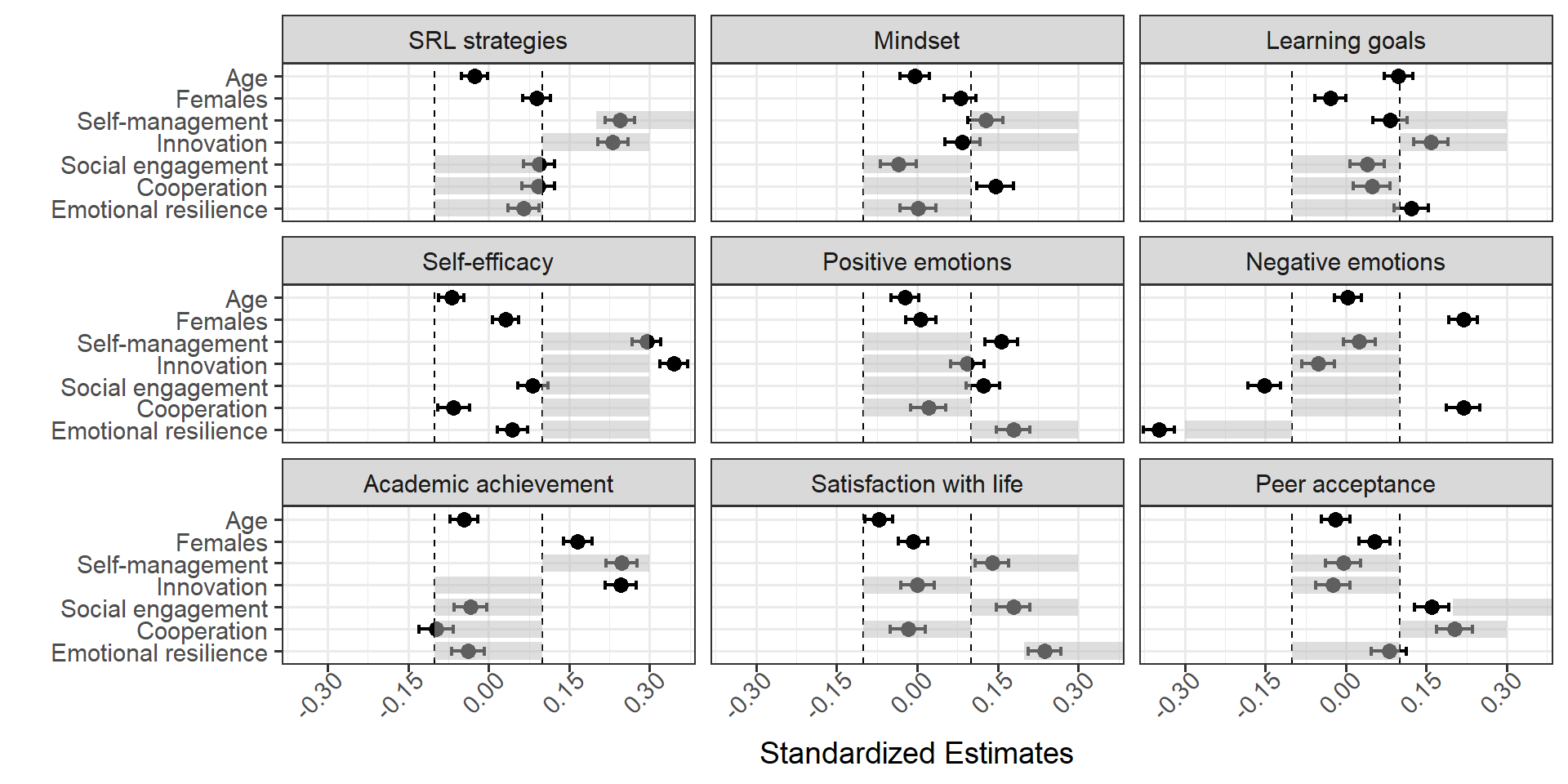
Results - Do SEB skills correlate with outcomes?

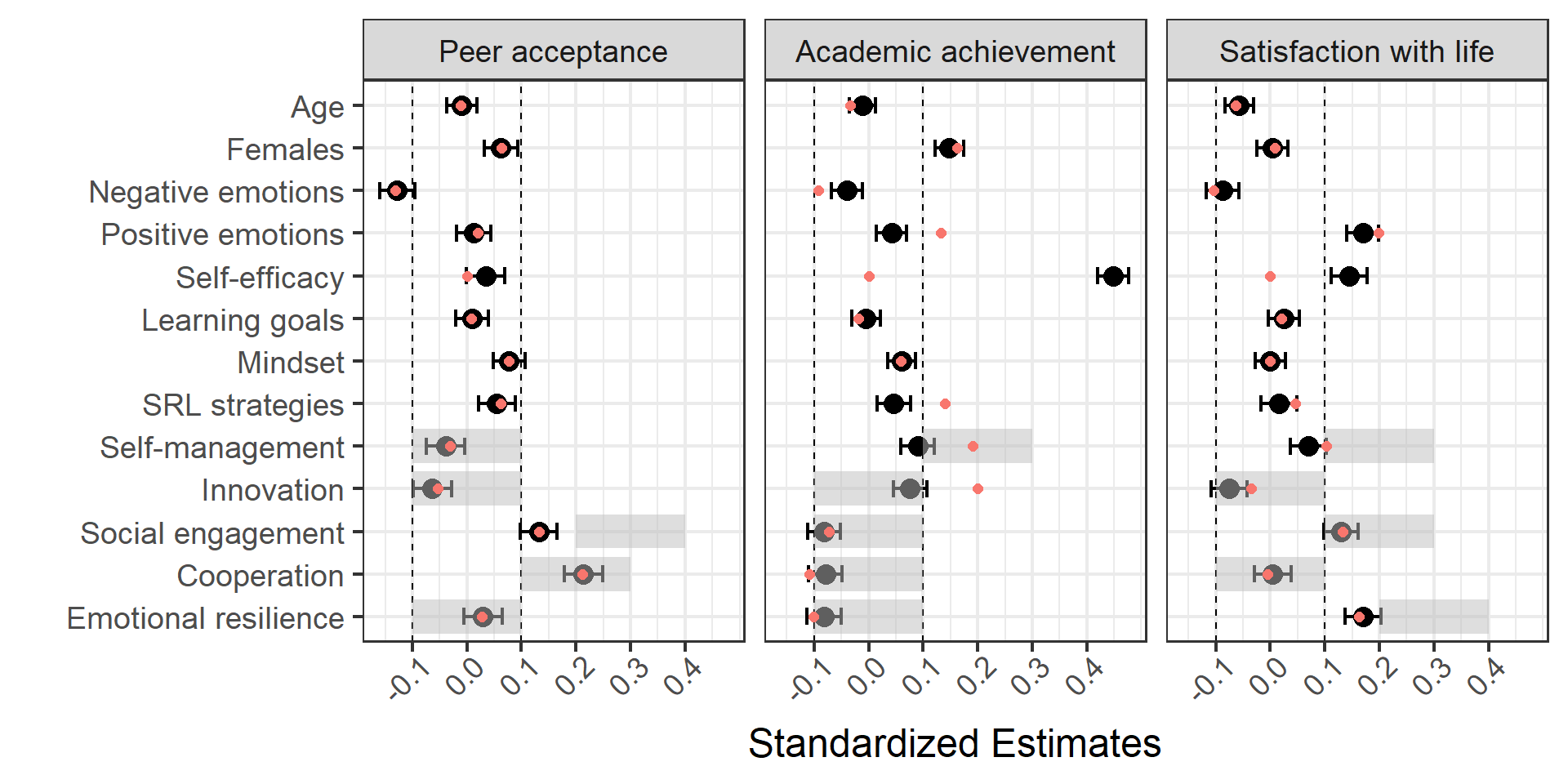
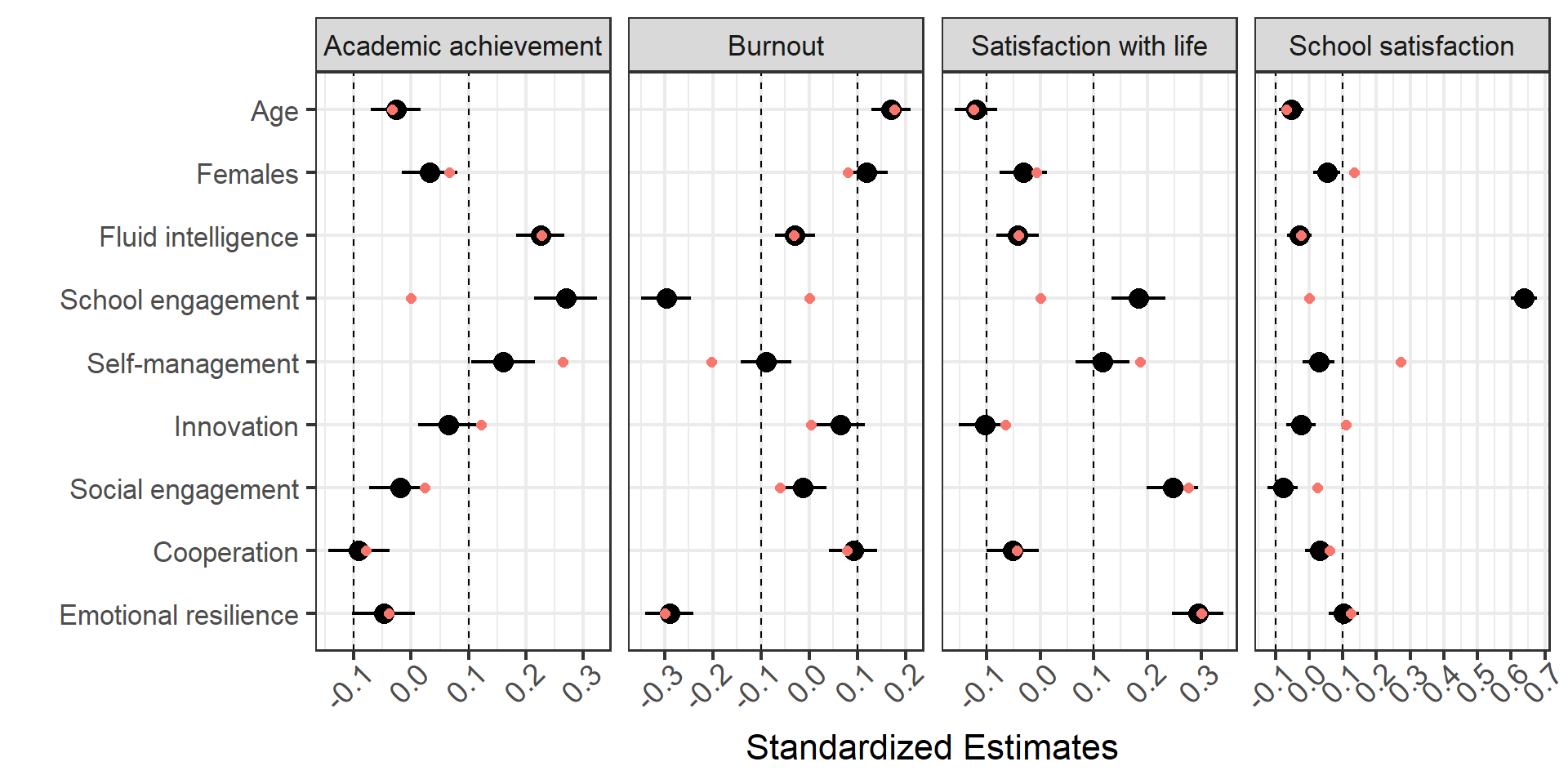
Results - Do SEB skills predict outcomes beyond SRL?

Study 2

Pellegrino, Meneghetti, Carretti & Feraco (under review)

Results - Do SEB skills predict outcomes beyond engagement?

Conclusions and Discussion

SEB at school

  • Social, emotional, and behavioral skills resulted important for
    • SRL factors (self-management + innovation + emotional resilience)
    • Academic achievement (self-management + innovation)
    • Non academic outcomes (cooperation + social engagement + emotional resilience)

BUT

  • When considering SRL factors:
    • Associations with academic achievement almost disappear
    • They keep their role for non-academic outcomes

Integrating SEB and SRL frameworks

  • Our results (may) support the multiple frameworks proposed:
    • SEB skills as broader capabilities that may lead to the adoption of positive SRL behaviors and beliefs [students who perceive themselves as having strong SEB skills are more likely to engage in behaviors that support both academic success and social-emotional development8]
    • SEB may lead to higher achievement through mediated processes

This perfectly aligns with SEB definition of functional capacities that people use when they want or need to do so1: students will gain from these skills if they want to use them for studying.

Thank you all

Chiara Meneghetti Barbara Carretti Gerardo Pellegrino

Free slides here!

Data, code, and materials needed to reproduce these slides are available at: https://github.com/feracotommaso/Slides/

tommaso.feraco@unipd.it

References

1.
Soto, C. J., Napolitano, C. M. & Roberts, B. W. Taking Skills Seriously: Toward an Integrative Model and Agenda for Social, Emotional, and Behavioral Skills. Current Directions in Psychological Science 30, 26–33 (2021).
2.
Soto, C. J., Napolitano, C., Sewell, M. N., Yoon, H. J. R. & Roberts, B. Going beyond traits: Social, emotional, and behavioral skills matter for adolescents’ success. Social Psychological and Personality Science 15, 33–45 (2024).
3.
Ringwald, W. R. et al. More skill than trait, or more trait than skill? Relations of (mis)matches between personality traits and social, emotional, and behavioral skills with adolescent outcomes. European Journal of Personality (2025) doi:10.1177/08902070241309960.
4.
Feraco, T., Pellegrino, G., Casali, N., Carretti, B. & Meneghetti, C. Social, emotional, and behavioral skills in students with or without specific learning disabilities. Learning and Individual Differences 117, 102581 (2025).
5.
Wang, M.-T., Degol, J. L. & Henry, D. A. An integrative development-in-sociocultural-context model for childrens engagement in learning. American Psychologist 74, 1086–1102 (2019).
6.
7.
Collie, R. J. The development of social and emotional competence at school: An integrated model. International Journal of Behavioral Development 44, 76–87 (2020).
8.
Collie, R. J. & Martin, A. J. The academic and social-emotional flourishing framework. Learning and Individual Differences 114, 102523 (2024).
9.
Feraco, T. et al. The italian behavioral, emotional, and social skills inventory (BESSI-i). Journal of Personality Assessment 106, 750–764 (2024).
10.
De Beni, R. et al. Test AMOS - Abilità e motivazione allo studio: prove di valutazione e orientamento per la scuola secondaria di secondo grado e l’università: Nuova edizione. (Edizioni Centro Studi Erickson, 2014).
11.
12.
Brock, D. M., Sarason, I. G., Sanghvi, H. & Gurung, R. A. R. The Perceived Acceptance Scale: Development and Validation. Journal of Social and Personal Relationships 15, 5–21 (1998).
13.
Mameli, C. & Passini, S. Measuring four-dimensional engagement in school: A validation of the student engagement scale and of the agentic engagement scale. TPM - Testing, Psychometrics, Methodology in Applied Psychology 24, 527–541 (2017).
14.
Zappulla, C., Pace, U., Lo Cascio, V., Guzzo, G. & Huebner, E. S. Factor Structure and Convergent Validity of the Long and Abbreviated Versions of the Multidimensional Students Life Satisfaction Scale in an Italian Sample. Social Indicators Research 118, 57–69 (2014).
15.
16.
Cattell, R. B. A culture-free intelligence test. i. Journal of Educational Psychology 31, 161–179 (1940).