Specific factors beyond broad constructs
Distinctiveness, interpretability, and predictive validity
Why this extra?
- Many papers claim a specific factor or subscale is meaningful simply because a multidimensional model fits.
- But once a broader factor exists, the real question becomes:
Is the narrow factor still interpretable and useful after the broad/common variance is modeled?
- This deck focuses on that neglected question.
Warning
This deck of slides possibly invalidates many specific findings in the literature. BUT not being able to validate/measure a construct reliably, does not mean your theory is wrong, don’t worry…you just can’t test or study it.
Learning objectives
By the end, students should be able to:
- distinguish broad-factor validity from specific-factor validity
- explain why fit alone does not justify subscale interpretation
- compare correlated-factor, higher-order, bifactor, and bifactor(S-1) logic
- evaluate whether a specific factor is well-defined, reliable/determinate, and predictively useful
- avoid overstated claims from residualized or observed-score analyses
The motivating problem
Examples you will see in applied work:
- anxiety vs math anxiety
- intelligence vs executive functions
- neuroticism vs depression
- general psychopathology vs specific symptom dimensions
- general vs domain-specific self-efficacy
- mindset vs domain-specific mindset
These are not just “more factors”.
They are claims that a narrow construct remains meaningful (identifiable) once broader variance is present.
A useful reframe
Instead of asking:
“Does the subscale exist?”
Ask three separate questions:
Structural distinctiveness
Is there evidence for separable narrow variance once the broad factor is modeled?Interpretability
Is that narrow factor well-defined enough to discuss substantively?Criterion validity
Does it predict anything important above the broad factor?
Note
We’ll see that above the broad factor is not such an easy question to tackle, if you really want to tackle it.
Running example
Does math anxiety predict math performance above general anxiety?
That single sentence hides several different models and several different validity claims.
We need to ask:
- Is math anxiety psychometrically separable from general anxiety?
- Is the “specific” part reliable or mostly leftover noise?
- Does prediction survive latent modeling?
- Is the conclusion robust across plausible models?
What usually goes wrong
Common shortcut
- Fit a CFA with several related factors
- Note that the model fits “well enough”
- Use subscale scores in regression
- Claim “incremental validity”
The problem
That workflow often confuses:
- correlated constructs
- residualized variance
- measurement error
- predictive utility
- practical utility
Fit != truth
A model can fit well and still fail the question that matters here:
Is the specific factor interpretable and worth using?
For this topic, always separate:
- global fit (CFI/TLI/RMSEA/SRMR)
- local diagnostics (residuals, strain, improper estimates)
- factor quality (loadings, determinacy, H, omega-type indices)
- criterion usefulness (effect sizes, uncertainty, robustness, practical gain)
Four common model families
1. Correlated first-order factors
Broad overlap is represented through factor correlations.
2. Higher-order model
A broad factor explains the correlations among first-order factors.
3. Symmetrical bifactor model
All items load on a general factor and on one group factor.
4. Bifactor(S-1)
A theoretically chosen reference domain defines the general factor; other domains become specific residual factors.
Conceptual map
| Model | Broad variance | Narrow variance | Typical attraction | Main danger |
|---|---|---|---|---|
| Correlated factors | factor correlations | first-order factors | simple, familiar | “unique” meaning may be overstated |
| Higher-order | higher-order factor | first-order residualized on higher-order | broad vs domains | first-order meaning changes after higher-order layer |
| Bifactor | general factor on all items | orthogonal group factors | direct separation of common vs specific | overinterpretation, instability, identifiability problems |
| Bifactor(S-1) | reference-domain-defined general factor | residual domains | often more interpretable | requires strong theory and explicit reference choice |
What would count as evidence for a specific factor?
A defensible specific factor usually needs all of the following:
- plausible theory for why narrow variance should remain after common variance is modeled
- a model that also models the general factor in which the specific factor is statistically admissible and meaningfully defined
- adequate factor quality (not just significant loadings)
- criterion relations that are stable and not artifacts of scoring/measurement error
- reporting that makes clear what the factor means in that parameterization
The key warning
A “specific factor” is often residualized variance.
That can be scientifically meaningful.
But it can also be:
- method variance
- wording variance
- nuisance variance
- instability created by a difficult parameterization
- a narrow remainder with weak reliability
So the substantive question is not “is it significant?”
It is “what does this remainder represent?”
Observed-score incremental validity is especially risky
A common workflow is:
This looks intuitive, but it can be misleading when:
- both predictors contain measurement error
- they are strongly correlated
- “controlling for” one construct changes the meaning of the other
- “controlling for” is not what you are really doing
Important
All specific factors are strongly correlated with general factors and share common variance that can be explained by the broader factor.
Why SEM helps
Latent-variable models can help because they allow you to:
- model measurement error explicitly
- define what “broad” and “specific” mean
- compare alternative structures
- test criterion relations at the latent level
- inspect instability/improper solutions directly
- really “control for” the broader factor
But SEM does not magically solve poor theory or weak indicators.
A minimal decision sequence
- Start with theory
- Fit defensible measurement models (these should already model both factors)
- Compare broad+narrow representations
- Check local admissibility
- Inspect factor quality
- Only then test criterion relations
- Assess robustness and practical value
- Report cautiously
Suggested reporting language
Prefer:
“The residual narrow factor showed limited support and should be interpreted cautiously.”
or
“After modeling the broad factor, the specific factor retained interpretable variance and showed a modest latent association with the criterion.”
Avoid:
“The subscale demonstrated clear unique validity.”
unless the evidence is unusually strong and consistent.
Code & Simulation
Live coding setup
Simulate a broad + narrow factor
# Observed items
anx1 = .80*general_anxiety + rnorm(N)
anx2 = .80*general_anxiety + rnorm(N)
anx3 = .80*general_anxiety + rnorm(N)
anx4 = .80*general_anxiety + rnorm(N)
manx1 = .65*general_anxiety + .35*math_anxiety + rnorm(N)
manx2 = .65*general_anxiety + .35*math_anxiety + rnorm(N)
manx3 = .65*general_anxiety + .35*math_anxiety + rnorm(N)
manx4 = .65*general_anxiety + .35*math_anxiety + rnorm(N)Step 1: Factorial validity
‘Classical’ factor analysis
mod_class <- '
  math_anx =~ manx1 + manx2 + manx3 + manx4
'
fit <- cfa(mod_class, data = dat)
fitmeasures(fit, fit.measures = c("cfi","tli","rmsea","srmr"))
cfi tli rmsea srmr
1.000 1.001 0.000 0.008 lhs op rhs est se std.lv std.all
1 math_anx =~ manx1 1.000 0.000 0.849 0.642
2 math_anx =~ manx2 0.926 0.065 0.786 0.612
3 math_anx =~ manx3 1.029 0.069 0.873 0.685
4 math_anx =~ manx4 1.001 0.068 0.850 0.653
5 manx1 ~~ manx1 1.028 0.061 1.028 0.588
6 manx2 ~~ manx2 1.031 0.059 1.031 0.625
7 manx3 ~~ manx3 0.863 0.057 0.863 0.531
8 manx4 ~~ manx4 0.970 0.059 0.970 0.573
9 math_anx ~~ math_anx 0.720 0.075 1.000 1.000We would conclude our measure is valid as it shows perfect fit indices and high and equal loadings across all items
BUT WE ALSO COLLECTED DATA ON ‘ANXIETY’ IN GENERAL…a higher-order factor!
Competing model 1: correlated factors
mod_cf <- '
  math_anx =~ manx1 + manx2 + manx3 + manx4
  gen_anx =~ anx1 + anx2 + anx3 + anx4
  math_anx ~~ gen_anx
'
fit_cf <- sem(mod_cf, data = dat)
fitmeasures(fit_cf, fit.measures = c("cfi","tli","rmsea","srmr"))
cfi tli rmsea srmr
0.999 0.999 0.011 0.015 lhs op rhs est se std.lv std.all
1 math_anx =~ manx1 1.000 0.000 0.839 0.635
2 math_anx =~ manx2 0.978 0.061 0.821 0.639
3 math_anx =~ manx3 1.032 0.061 0.865 0.679
4 math_anx =~ manx4 0.992 0.062 0.832 0.640
5 gen_anx =~ anx1 1.000 0.000 0.822 0.646
6 gen_anx =~ anx2 0.927 0.059 0.762 0.618
7 gen_anx =~ anx3 0.994 0.061 0.817 0.643
8 gen_anx =~ anx4 0.906 0.060 0.745 0.586
9 math_anx ~~ gen_anx 0.636 0.049 0.922 0.922
10 manx1 ~~ manx1 1.044 0.055 1.044 0.597
11 manx2 ~~ manx2 0.974 0.052 0.974 0.591
12 manx3 ~~ manx3 0.877 0.049 0.877 0.539
13 manx4 ~~ manx4 1.000 0.053 1.000 0.591
14 anx1 ~~ anx1 0.942 0.051 0.942 0.582
15 anx2 ~~ anx2 0.940 0.049 0.940 0.618
16 anx3 ~~ anx3 0.949 0.051 0.949 0.587
17 anx4 ~~ anx4 1.063 0.054 1.063 0.657
18 math_anx ~~ math_anx 0.704 0.069 1.000 1.000
19 gen_anx ~~ gen_anx 0.676 0.066 1.000 1.000Competing model 2: higher-order representation
mod_ho <- '
  math_anx =~ manx1 + manx2 + manx3 + manx4
  gen_anx =~ anx1 + anx2 + anx3 + anx4 + math_anx
'
fit_ho <- sem(mod_ho, data = dat)
fitmeasures(fit_ho, fit.measures = c("cfi","tli","rmsea","srmr"))
cfi tli rmsea srmr
0.999 0.999 0.011 0.015 lhs op rhs est se std.lv std.all
1 math_anx =~ manx1 1.000 0.000 0.839 0.635
2 math_anx =~ manx2 0.978 0.061 0.821 0.639
3 math_anx =~ manx3 1.032 0.061 0.865 0.679
4 math_anx =~ manx4 0.992 0.062 0.832 0.640
5 gen_anx =~ anx1 1.000 0.000 0.822 0.646
6 gen_anx =~ anx2 0.927 0.059 0.762 0.618
7 gen_anx =~ anx3 0.994 0.061 0.817 0.643
8 gen_anx =~ anx4 0.906 0.060 0.745 0.586
9 gen_anx =~ math_anx 0.941 0.063 0.922 0.922
10 manx1 ~~ manx1 1.044 0.055 1.044 0.597
11 manx2 ~~ manx2 0.974 0.052 0.974 0.591
12 manx3 ~~ manx3 0.877 0.049 0.877 0.539
13 manx4 ~~ manx4 1.000 0.053 1.000 0.591
14 anx1 ~~ anx1 0.942 0.051 0.942 0.582
15 anx2 ~~ anx2 0.940 0.049 0.940 0.618
16 anx3 ~~ anx3 0.949 0.051 0.949 0.587
17 anx4 ~~ anx4 1.063 0.054 1.063 0.657
18 math_anx ~~ math_anx 0.105 0.029 0.149 0.149
19 gen_anx ~~ gen_anx 0.676 0.066 1.000 1.000Competing model 3: bifactor representation
mod_bi <- '
  math_anx =~ manx1 + manx2 + manx3 + manx4
  gen_anx =~ anx1 + anx2 + anx3 + anx4 + manx1 + manx2 + manx3 + manx4

  gen_anx ~~ 0*math_anx
'
fit_bi <- sem(mod_bi, data = dat)
fitmeasures(fit_bi, fit.measures = c("cfi","tli","rmsea","srmr"))
cfi tli rmsea srmr
1.000 1.000 0.000 0.012 lhs op rhs est se std.lv std.all
1 math_anx =~ manx1 1.000 0.000 0.352 0.266
2 math_anx =~ manx2 0.467 0.231 0.165 0.128
3 math_anx =~ manx3 1.002 0.328 0.353 0.277
4 math_anx =~ manx4 1.230 0.438 0.433 0.333
5 gen_anx =~ anx1 1.000 0.000 0.824 0.647
6 gen_anx =~ anx2 0.925 0.059 0.762 0.618
7 gen_anx =~ anx3 0.988 0.061 0.814 0.640
8 gen_anx =~ anx4 0.906 0.060 0.746 0.586
9 gen_anx =~ manx1 0.931 0.065 0.767 0.580
10 gen_anx =~ manx2 0.960 0.064 0.791 0.616
11 gen_anx =~ manx3 0.964 0.063 0.794 0.622
12 gen_anx =~ manx4 0.910 0.064 0.749 0.576
13 math_anx ~~ gen_anx 0.000 0.000 0.000 0.000
14 manx1 ~~ manx1 1.036 0.063 1.036 0.593
15 manx2 ~~ manx2 0.995 0.051 0.995 0.604
16 manx3 ~~ manx3 0.871 0.058 0.871 0.536
17 manx4 ~~ manx4 0.943 0.078 0.943 0.557
18 anx1 ~~ anx1 0.940 0.051 0.940 0.581
19 anx2 ~~ anx2 0.940 0.049 0.940 0.618
20 anx3 ~~ anx3 0.954 0.051 0.954 0.590
21 anx4 ~~ anx4 1.061 0.054 1.061 0.656
22 math_anx ~~ math_anx 0.124 0.060 1.000 1.000
23 gen_anx ~~ gen_anx 0.678 0.066 1.000 1.000What to compare across models
Do not ask only “which model fits best?”
Also compare:
- whether parameter estimates are admissible
- whether the specific factor has meaningful loadings
- whether the narrow factor is determinate/reliable enough
- whether conclusions change under plausible reparameterizations
Factor quality matters
For broad vs specific claims, add checks such as:
- salient standardized loadings
- factor determinacy
- construct replicability / (H)
- omega-based indices
- explained common variance (for bifactor contexts)
A specific factor with low determinacy or weak replicability is hard to interpret, even if global fit looks good.
Optional indices for bifactor models
# After extracting standardized loadings / residual variances,
# inspect indices such as omega hierarchical, omega subscale,
# ECV, PUC, H, and factor determinacy.
library(BifactorIndicesCalculator)
bifactorIndices(fit_bi)
$ModelLevelIndices
ECV.gen_anx PUC Omega.gen_anx OmegaH.gen_anx
0.9157073 0.7857143 0.8401305 0.8060378
$FactorLevelIndices
ECV_SS ECV_SG ECV_GS Omega OmegaH H FD
math_anx 0.1609079 0.08429275 0.8390921 0.7465064 0.1117941 0.2314392 0.4835506
gen_anx 0.9157073 0.91570725 0.9157073 0.8401305 0.8060378 0.8277219 0.9011336
$ItemLevelIndices
IECV
manx1 0.8256587
manx2 0.9584576
manx3 0.8347653
manx4 0.7492171
anx1 1.0000000
anx2 1.0000000
anx3 1.0000000
anx4 1.0000000Step 2 - Criterion validity
‘Classical’ approach
               lhs op      rhs   est    se std.lv std.all
5 math_performance  ~ math_anx 0.342 0.047  0.288   0.272
Call:
lm(formula = math_performance ~ mat_anx, data = dat)

Residuals:
     Min       1Q   Median       3Q      Max
-3.15021 -0.72446  0.01687  0.70175  3.01907

Coefficients:
            Estimate Std. Error t value Pr(>|t|)
(Intercept)  0.02053    0.03263   0.629    0.529
mat_anx      0.25212    0.03351   7.523 1.19e-13 ***
---
Signif. codes:  0 '***' 0.001 '**' 0.01 '*' 0.05 '.' 0.1 ' ' 1

Residual standard error: 1.032 on 998 degrees of freedom
Multiple R-squared:  0.05366,   Adjusted R-squared:  0.05271
F-statistic: 56.59 on 1 and 998 DF,  p-value: 1.194e-13
We would conclude our measure is a good predictor of math performance, but is it for real?
…we know from the data generating model that it should not be! Isn’t it?
SEM with correlated factors
                lhs op      rhs    est    se std.lv std.all
10 math_performance  ~ math_anx -0.126 0.246 -0.105  -0.100
11 math_performance  ~  gen_anx  0.519 0.254  0.425   0.401
Call:
lm(formula = math_performance ~ mat_anx + anxiety, data = dat)

Residuals:
     Min       1Q   Median       3Q      Max
-3.15389 -0.72012  0.01263  0.71534  2.85762

Coefficients:
            Estimate Std. Error t value Pr(>|t|)
(Intercept)  0.02606    0.03230   0.807   0.4199
mat_anx      0.10840    0.04486   2.416   0.0159 *
anxiety      0.22371    0.04704   4.756 2.26e-06 ***
---
Signif. codes:  0 '***' 0.001 '**' 0.01 '*' 0.05 '.' 0.1 ' ' 1

Residual standard error: 1.021 on 997 degrees of freedom
Multiple R-squared:  0.07466,   Adjusted R-squared:  0.0728
F-statistic: 40.22 on 2 and 997 DF,  p-value: < 2.2e-16
What’s going on here? Why do sum scores suggest both factors have an effect?
Bifactor representation
                lhs op      rhs   est    se std.lv std.all
14 math_performance  ~ math_anx 0.064 0.197  0.023   0.022
15 math_performance  ~  gen_anx 0.383 0.049  0.314   0.297
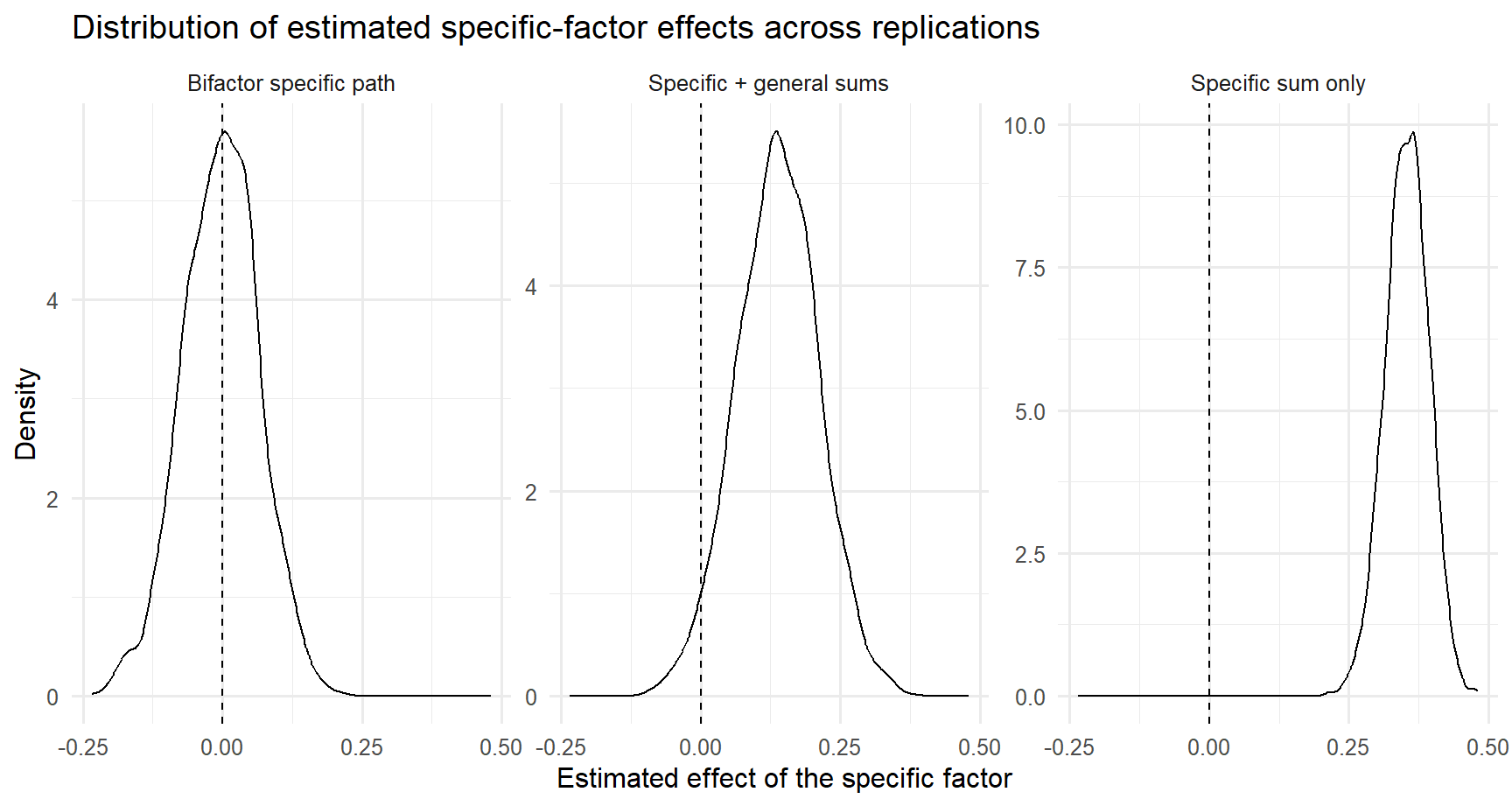
Simulation results (bg=.40; bs=0; rgs=.40)
| model | mean_estimate | sd_estimate | prop_significant |
|---|---|---|---|
| Bifactor specific path | -0.004 | 0.068 | 0.059 |
| Specific + general sums | 0.137 | 0.073 | 0.452 |
| Specific sum only | 0.354 | 0.039 | 1.000 |
Concluding remarks
Implications for non-validation results
Well, everything applies to all contexts. You cannot just control for intelligence using the Raven matrices…you should model intelligence as a general latent factor and test whether your specific executive funtion measures, visuo-spatial abilities, creative skills predict the desired outcome beyond the latent g factor.
This is well known in literature…but we always ignore it (Westfall & Yarkoni, 2016)
A practical rubric
| Question | If “no” | Consequence |
|---|---|---|
| Is the specific factor theoretically motivated? | weak theory | do not over-interpret |
| Are estimates admissible and stable? | improper / unstable | stop and rethink model |
| Is the specific factor well-defined? | weak loadings / low determinacy | avoid strong substantive claims |
| Does it add latent predictive information? | null / fragile effects | no evidence for unique criterion value |
| Is the gain practically meaningful? | trivial improvement | probably not worth using |
Three take-home messages
Specific factors are not automatically meaningful
Good fit is not enough.Interpretability comes before prediction claims
First ask whether the factor is well-defined.Incremental validity must be modeled carefully
Measurement error, parameterization, and out-of-sample performance all matter.
Self-study exercises
Take a scale with a plausible broad+narrow structure from your own area.
Write down what the “specific factor” would mean after broad variance is removed.Fit at least two plausible measurement models.
Compare not just fit, but the meaning of the narrow factor.Test one criterion relation.
Ask whether the conclusion is robust across models.If you use observed scores, add a cross-validated prediction comparison.
What I would report in a paper
Minimum reporting before claiming “specific-factor validity”:
- why a broad+narrow representation is theoretically expected
- which competing measurement models were tested
- global fit + local diagnostics
- factor quality indices for the specific factor
- the exact criterion model
- robustness of the criterion conclusion across plausible specifications
- whether the predictive gain is practically meaningful
Further reading
- Westfall & Yarkoni (2016). Statistically controlling for confounding constructs is harder than you think.
- Eid et al. (2018). Bifactor models for predicting criteria by general and specific factors: Problems of nonidentifiability and alternative solutions.
- Rodriguez, Reise, & Haviland (2016). Evaluating bifactor models: Calculating and interpreting statistical indices.
- Blogposts: