library(lavaan)
dSEM <- simulateData("xi =~ .74*x1 + .65*x2 # note the =~
                      eta =~ .56*y1 + .75*y2
                      eta ~ .30*xi # and the ~ only
", sample.nobs = 1000)Structural Equation Models
Measurement + structure (capstone)
Tommaso Feraco
Today in the workflow
Specify → Identify → Estimate → Evaluate → Revise/Report
Today: full SEM = measurement model (CFA) + structural model (paths among latent variables).
We will repeat fit/diagnostics on purpose: by now it should become a habit (global + local).
Learning objectives
By the end of this session you should be able to:
- Connect the CFA measurement model to the SEM structural model (two-step mindset)
- Understand how SEM is represented in matrices (\(Λ\), \(B\), \(Γ\), \(Φ\), \(Ψ\), \(Θ\))
- Fit a full SEM in lavaan and interpret parameters + fit indices + diagnostics
- Compare plausible SEMs (nested comparisons) and justify modifications transparently
Structural equation models
Up to now, we have seen how to model the relationship between different variables/constructs at the same time (path analysis) and how to build a measurement model with one or more latent variables.
A complete SEM takes both of these things and put them together.
The two parts of a SEM
The measurement model
\(x = \Lambda_x\xi + \delta\)
\(y = \Lambda_y\eta + \epsilon\)
The structural model
- \(\eta = B\eta + \Gamma\xi + \zeta\)
already seen in the first slides
Matrices
These models (can) have all the possible matrices:
Loadings and coefficients matrices
- \(\Lambda^x\) - relation among \(\xi\) and \(x\)
- \(\Lambda^y\) - relation among \(\eta\) and \(y\)
- \(B\) - relation among \(\eta\) and \(\eta\)
- \(\Gamma\) - relation among \(\xi\) and \(\eta\)
Covariance matrices
- \(\Theta^\delta\) - \(x\) errors
- \(\Theta^\epsilon\) - \(y\) errors
- \(\Psi\) - \(\eta\) errors
- \(\Phi\) - relations among \(\eta\)
Different models are allowed based on the way we define relationships among variables
… lavaan matrices
lavaan does not distinguish between endogenous and exogenous variables. This leads to an easier parametrization and to four matrices only:
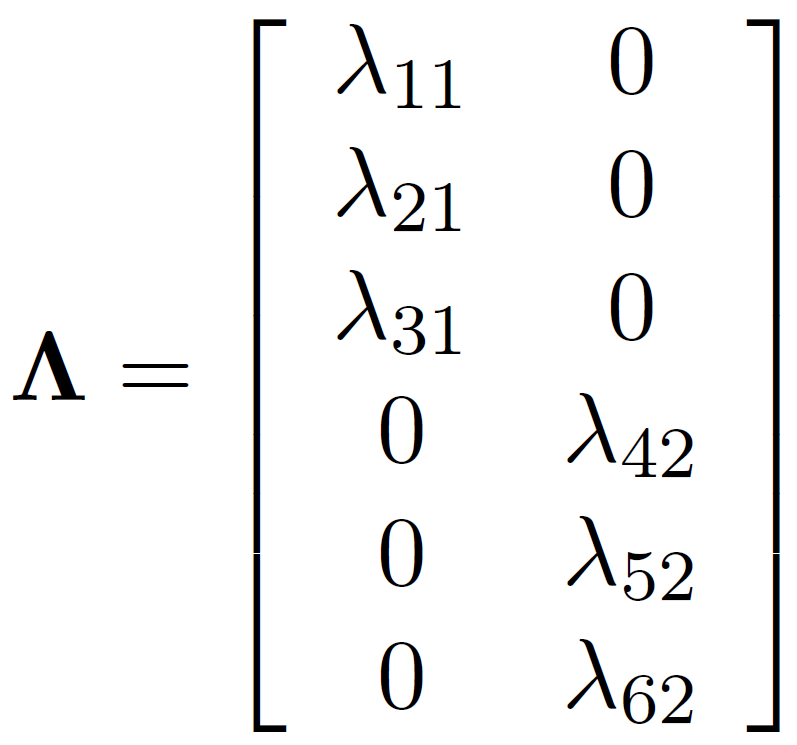
- \(\Lambda\) factor loadings matrix \([p x m]\)
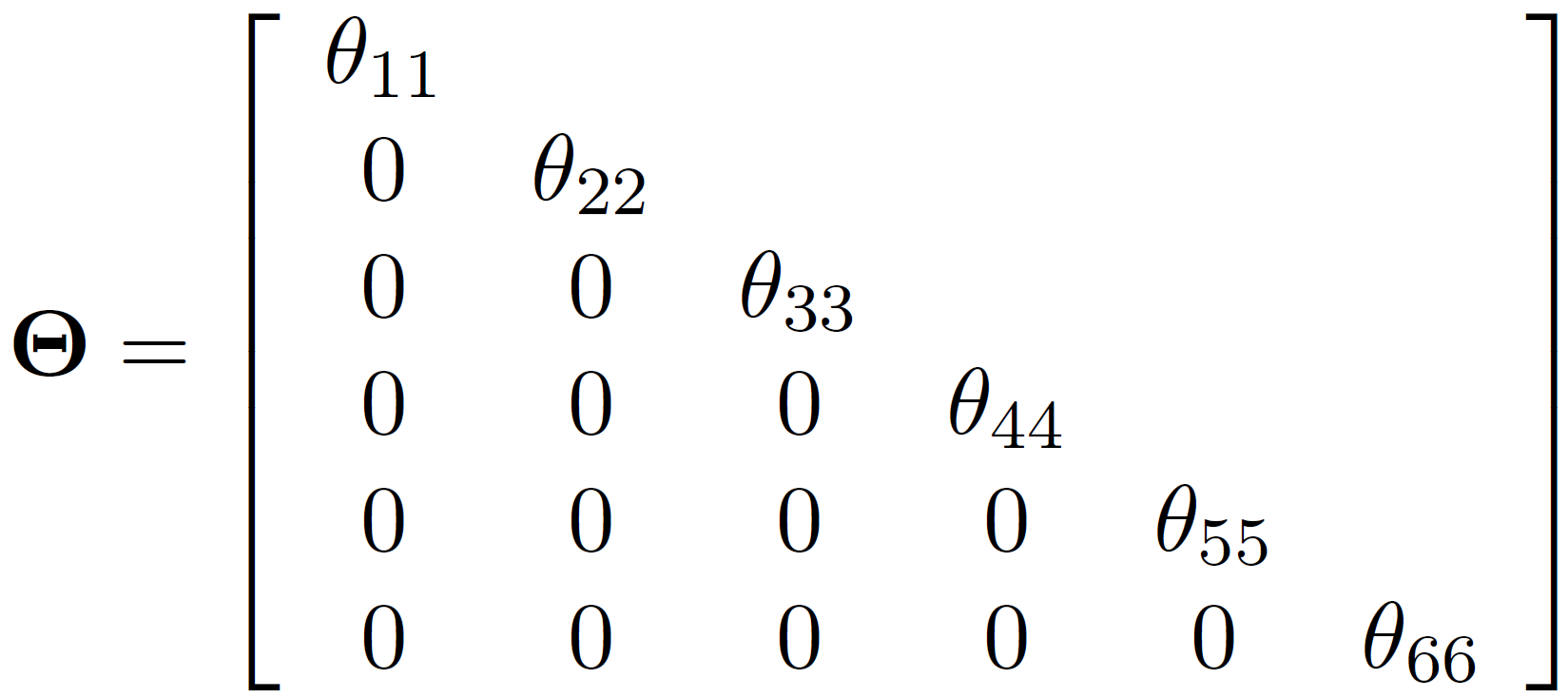
- \(\Theta\) measurement residual errors covariance matrix \([p x p]\)
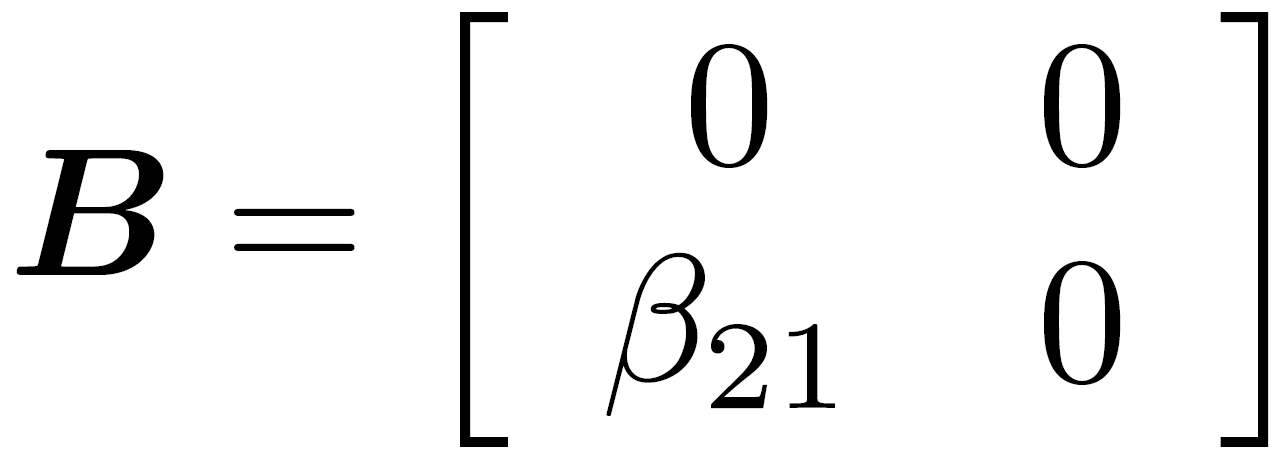
- \(B\) regression coefficients matrix \([m x m]\)
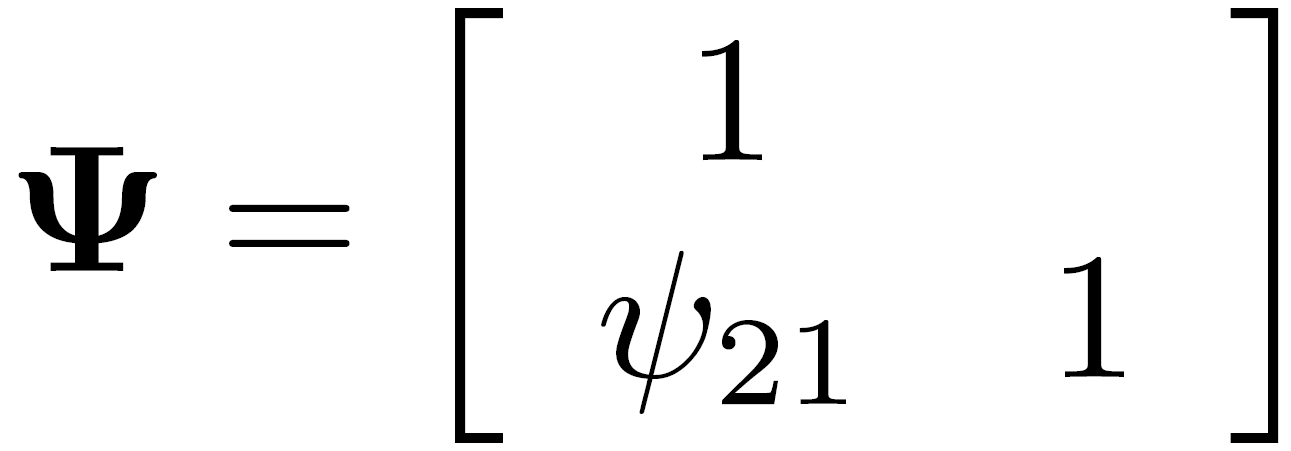
- \(\Psi\) residual structural errors covariance matrix \([m x m]\)
With p being the number of manifest variables and m being the number of latent variables.
The lavaan matrices
Lambda: matrix of loadings
Beta: regression coefficients
Psi: residual structural errors matrix
Theta: observed variance-covariance matrix
A SEM example - simulation
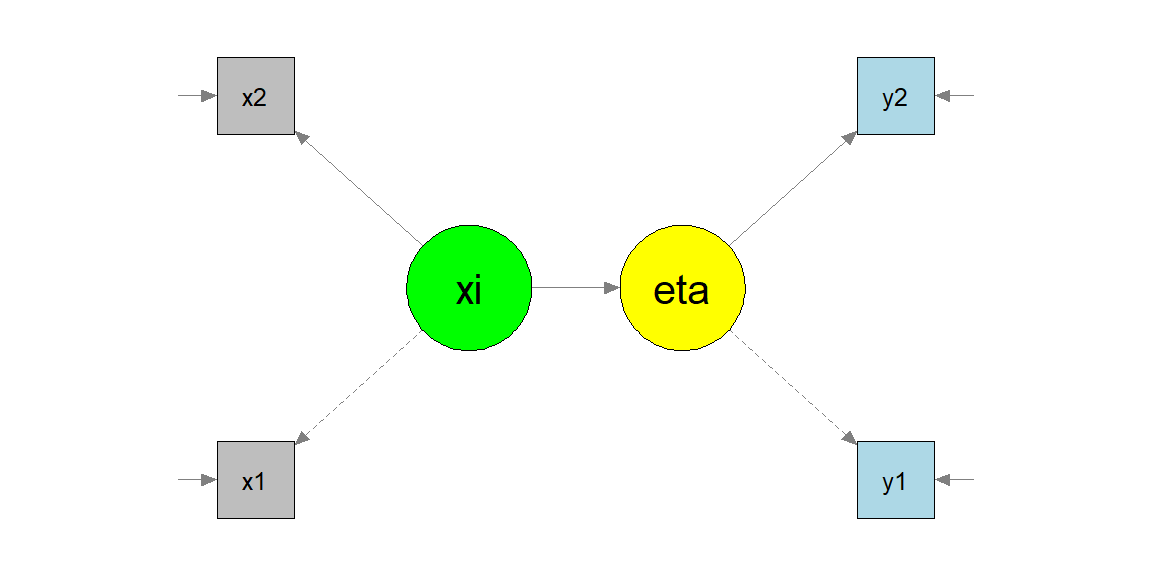
A SEM example - specification and constraints
Constraints
To estimate the model we need to set constraints:
- the
semorcfafunctions default is setting to 1 one loading for each latent variable - an alternative is to standardized latent variables using the
std.lv = TRUEoption
Constraints: default
[...]
Latent Variables:
                   Estimate  Std.Err  z-value  P(>|z|)   Std.lv  Std.all
  xi =~
    x1                1.000                               0.939    0.731
    x2                0.558    0.221    2.529    0.011    0.524    0.445
  eta =~
    y1                1.000                               0.538    0.458
    y2                1.633    0.619    2.640    0.008    0.879    0.686

[...]
Variances:
                   Estimate  Std.Err  z-value  P(>|z|)   Std.lv  Std.all
   .x1                0.768    0.349    2.203    0.028    0.768    0.466
   .x2                1.110    0.119    9.326    0.000    1.110    0.802
   .y1                1.093    0.120    9.122    0.000    1.093    0.791
   .y2                0.868    0.294    2.949    0.003    0.868    0.529
    xi                0.882    0.353    2.497    0.013    1.000    1.000
   .eta               0.272    0.106    2.564    0.010    0.941    0.941

[...]
Constraints: std.lv=T
[...]
Latent Variables:
                   Estimate  Std.Err  z-value  P(>|z|)   Std.lv  Std.all
  xi =~
    x1                0.939    0.188    4.994    0.000    0.939    0.731
    x2                0.524    0.109    4.808    0.000    0.524    0.445
  eta =~
    y1                0.522    0.102    5.128    0.000    0.538    0.458
    y2                0.853    0.171    4.997    0.000    0.879    0.686

[...]
Variances:
                   Estimate  Std.Err  z-value  P(>|z|)   Std.lv  Std.all
   .x1                0.768    0.349    2.203    0.028    0.768    0.466
   .x2                1.110    0.119    9.326    0.000    1.110    0.802
   .y1                1.093    0.120    9.122    0.000    1.093    0.791
   .y2                0.868    0.294    2.949    0.003    0.868    0.529
    xi                1.000                               1.000    1.000
   .eta               1.000                               0.941    0.941

[...]
lavaan matrices
$lambda
      xi   eta
x1 0.731 0.000
x2 0.445 0.000
y1 0.000 0.458
y2 0.000 0.686

$theta
      x1    x2    y1    y2
x1 0.466
x2 0.000 0.802
y1 0.000 0.000 0.791
y2 0.000 0.000 0.000 0.529
$psi
xi eta
xi 1.000
eta 0.000 0.941
$beta
xi eta
xi 0.000 0
eta 0.242 0SEM identification
Once again, remember that identification is a topic relevant to all structural equation models.
If an unknown parameter in \(\theta\) can be written as a function of one or more elements of \(\Sigma\), that parameter is identified.
If all unknown parameters in \(\theta\) are identified, the model is identified.
- the t-rule (again)
- the Two-Steps rule
Two-Steps rule
Step 1. Treat the model as a confirmatory factor analysis: view the original \(x\) and \(y\) as \(x\) variables and the original \(\xi\) and \(\eta\) as \(\xi\) variables. The only relationship between latent variables of interest are their variance and covariance \(Phi\). That is, ignore the \(B\), \(\Gamma\), and \(\Psi\) elements.
\(\rightarrow\) apply CFA identification rules
Step 2. Examine the latent variable equation of the original model (\(\eta = B\eta + \Gamma\xi + \zeta\)), assuming that each latent variable is an observed variable that is perfectly measured.
Two-Steps rule
Summary
If the first step shows that the measurement parameters are identified and the second step shows that the latent variable model parameters also are identified, then this is suficient to identify the whole model.
Political democracy dataset
Bollen (1989) studied the relation between industrialization in 1960 and political democracy of developing countries in 1960 and 1965.
We have 11 variables
    y1  y2    y3  y4   y5   y6    y7   y8   x1   x2   x3
1 2.50 0.0  3.33 0.0 1.25 0.00  3.73 3.33 4.44 3.64 2.56
2 1.25 0.0  3.33 0.0 6.25 1.10  6.67 0.74 5.38 5.06 3.57
3 7.50 8.8 10.00 9.2 8.75 8.09 10.00 8.21 5.96 6.26 5.22
A first latent variable, Industrialization (\(I = x_1 + x_2 + x_3\))
A second latent variable, political democracy in 1960 (\(D60 = y_1 + y_2 + y_3 + y_4\))
A third latent variable, political democracy in 1965 (\(D65 = y_5 + y_6 + y_7 + y_8\)).
LET'S APLLY THE TWO-STEPS RULE
Step 1 - model plot
The CFA model
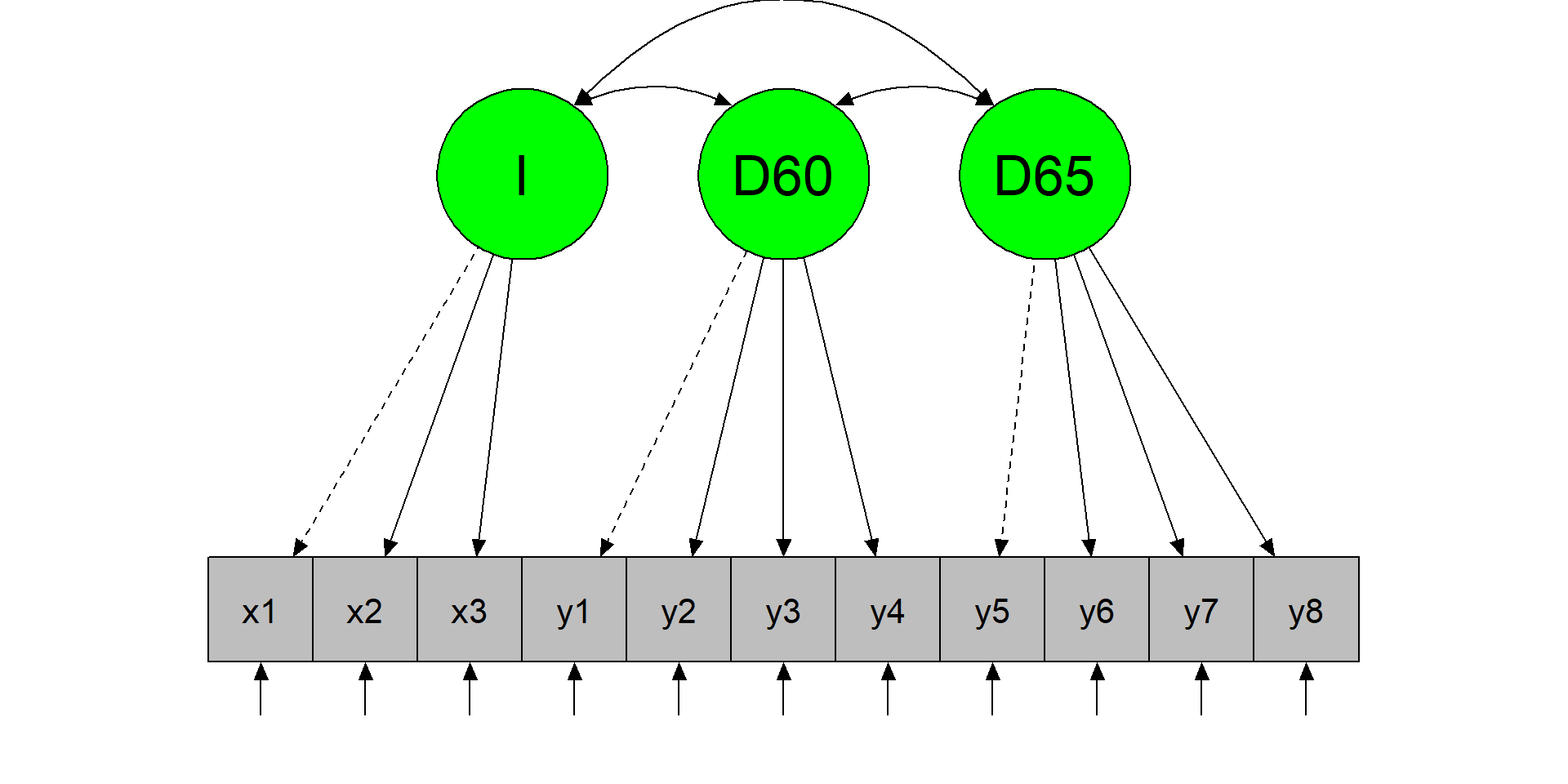
Step 1 - model specification and results
The CFA model
PARAMETERS ARE ALL IDENTIFIED. LET'S GO TO STEP 2
Step 2 - model plot
The structural model
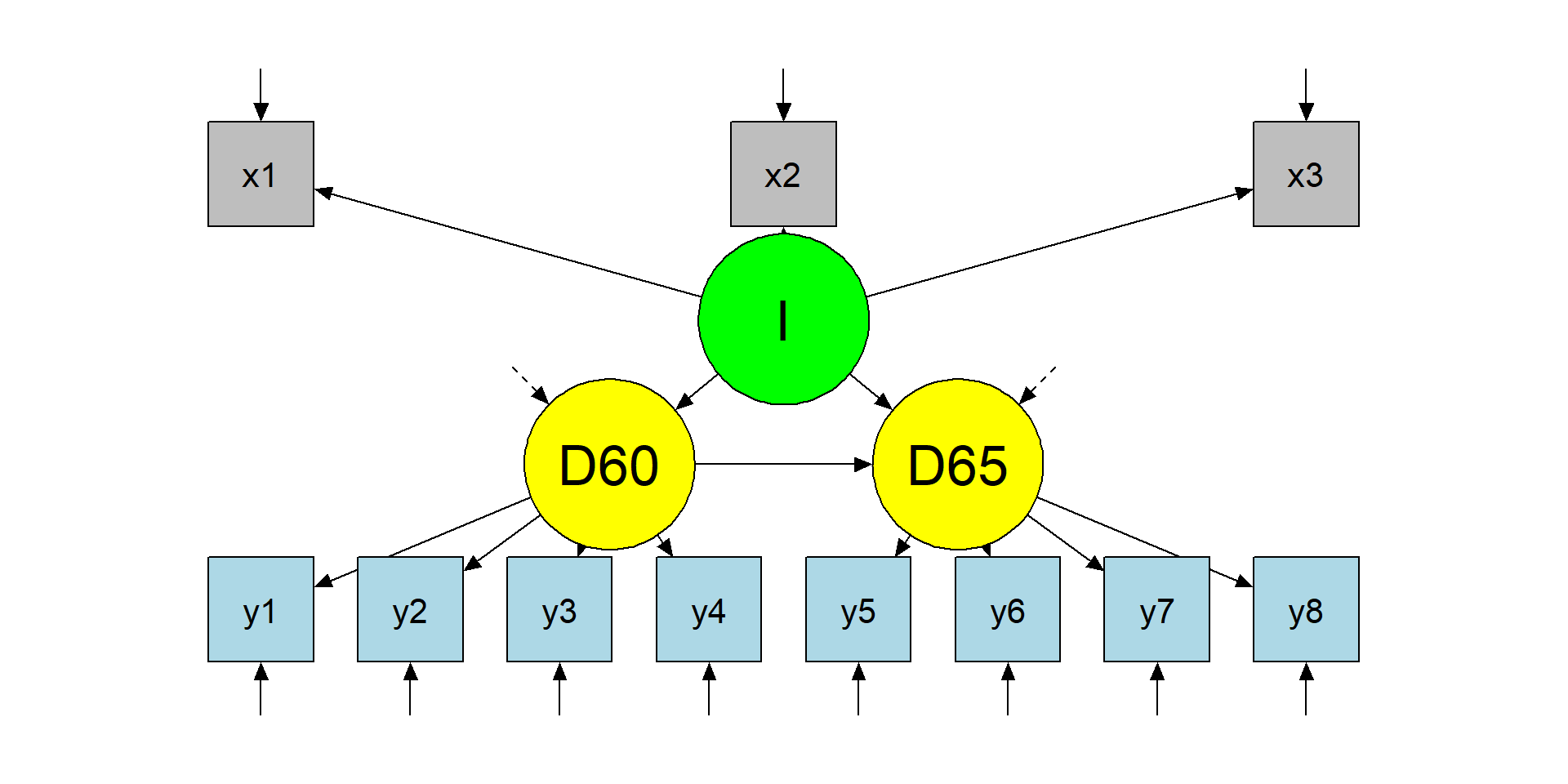
Step 2 - model specification and results
The structural model
STRUCTURAL PARAMETERS ARE ALSO IDENTIFIED.
LET'S DEFINE THE MODEL CONSIDERING LONGITUDINAL MEASURES
Final model
The modified model
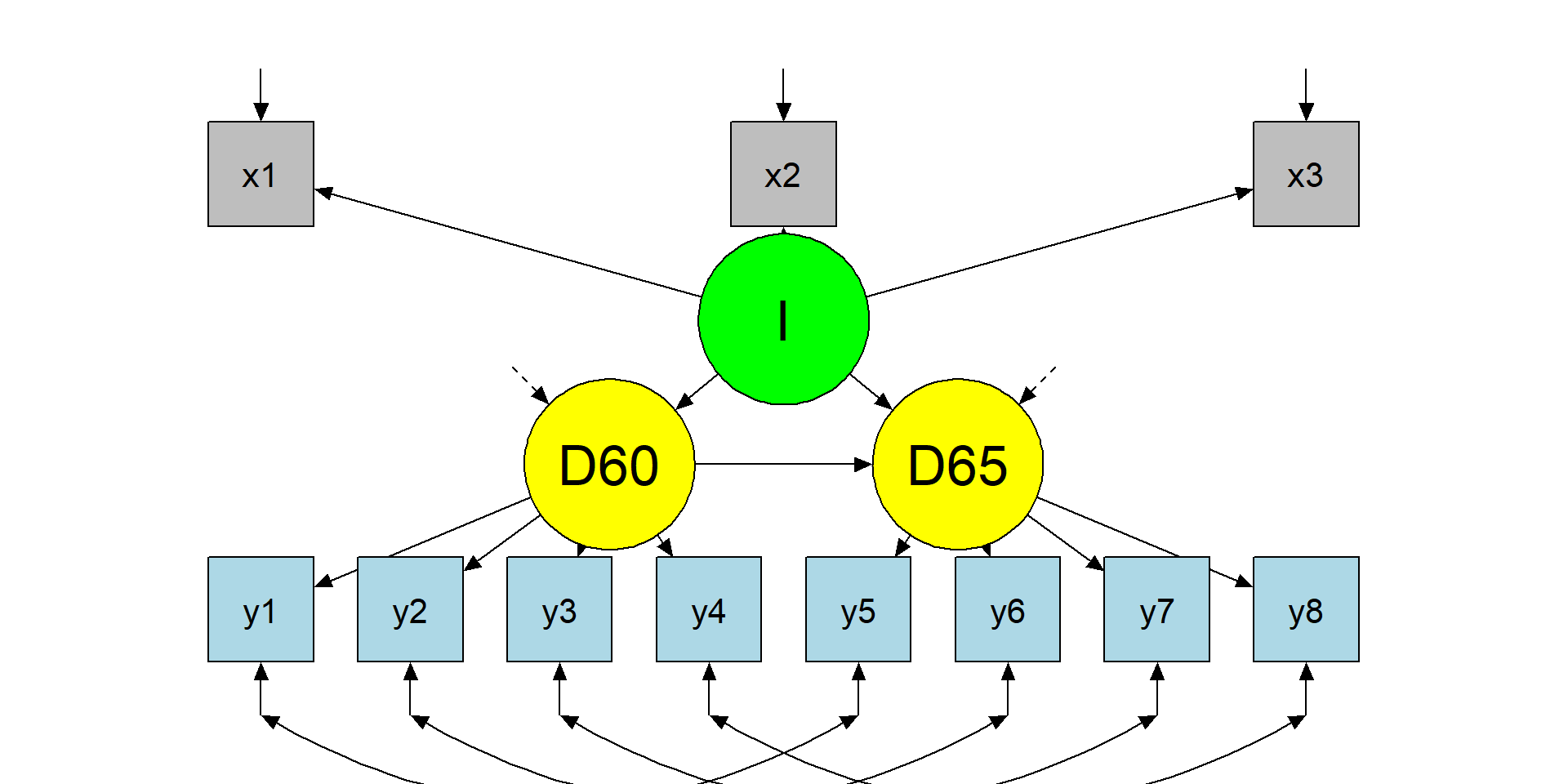
Final model specification
The modified model
SAME ITEMS AT DIFFERENT TIME POINTS HAVE CORRELATED RESIDUALS
Final model results
The modified model
lavaan 0.6-19 ended normally after 58 iterations

  Estimator                                         ML
  Optimization method                           NLMINB
  Number of model parameters                        29

  Number of observations                            75

Model Test User Model:

  Test statistic                                50.835
  Degrees of freedom                                37
P-value (Chi-square) 0.064 cfi srmr rmsea
0.97952316 0.05011528 0.07060935 MODEL FIT IS GOOD!
Model comparisons
Warning: lavaan->lavTestLRT():
   some models have the same degrees of freedom
Chi-Squared Difference Test

     Df    AIC    BIC  Chisq Chisq diff   RMSEA Df diff Pr(>Chisq)
fit3 37 3166.3 3233.5 50.835
fit1 41 3179.9 3237.9 72.462     21.626 0.24239       4  0.0002378 ***
fit2 41 3179.9 3237.9 72.462      0.000 0.00000       0
---
Signif. codes:  0 '***' 0.001 '**' 0.01 '*' 0.05 '.' 0.1 ' ' 1
Model comparisons
We can also compare the models using fit indices:
| chisq | df | cfi | tli | srmr | rmsea | aic | bic | |
|---|---|---|---|---|---|---|---|---|
| model1 | 72.462 | 41 | 0.953 | 0.938 | 0.055 | 0.101 | 3179.918 | 3237.855 |
| model2 | 72.462 | 41 | 0.953 | 0.938 | 0.055 | 0.101 | 3179.918 | 3237.855 |
| model3 | 50.835 | 37 | 0.980 | 0.970 | 0.050 | 0.071 | 3166.292 | 3233.499 |
WHAT IS THE BEST MODEL? QUESTIONS? COMMENTS?
Exercise
The EAT dataset
The dataset includes 13 items that measure ‘peer pressure’, ‘social media use’, ‘social comparison’, and ‘eating disorders’.
    PP1   PP2   PP3   PP4   SM1   SM2   SM3   SM4   SC1   SC2   SC3   ED1   ED2
1  0.23  1.91  0.59 -0.70  2.31  1.06  1.43 -0.77  1.18  2.20  0.18 -0.38  1.61
2 -0.65 -3.18 -0.84 -0.43  0.69  0.10  1.24  0.51 -1.87 -1.17 -1.23 -1.74 -1.73
3  0.26 -1.46 -0.43 -0.05 -0.21 -0.46 -0.02  1.26  1.39  1.03  0.90  1.07  2.04
4 -0.68 -0.29 -0.08 -2.24 -0.64  0.47 -0.76  0.58  1.22  0.97  2.73  0.71  0.32
5 -0.06  0.89  0.04 -0.41  0.17  1.02  0.18  0.61  3.74  1.38  1.85  1.25  0.66
6 -0.29 -2.74 -0.52  2.58  0.15 -1.08  1.08  0.99  1.32 -0.24  0.93 -0.97 -0.68
The theoretical model
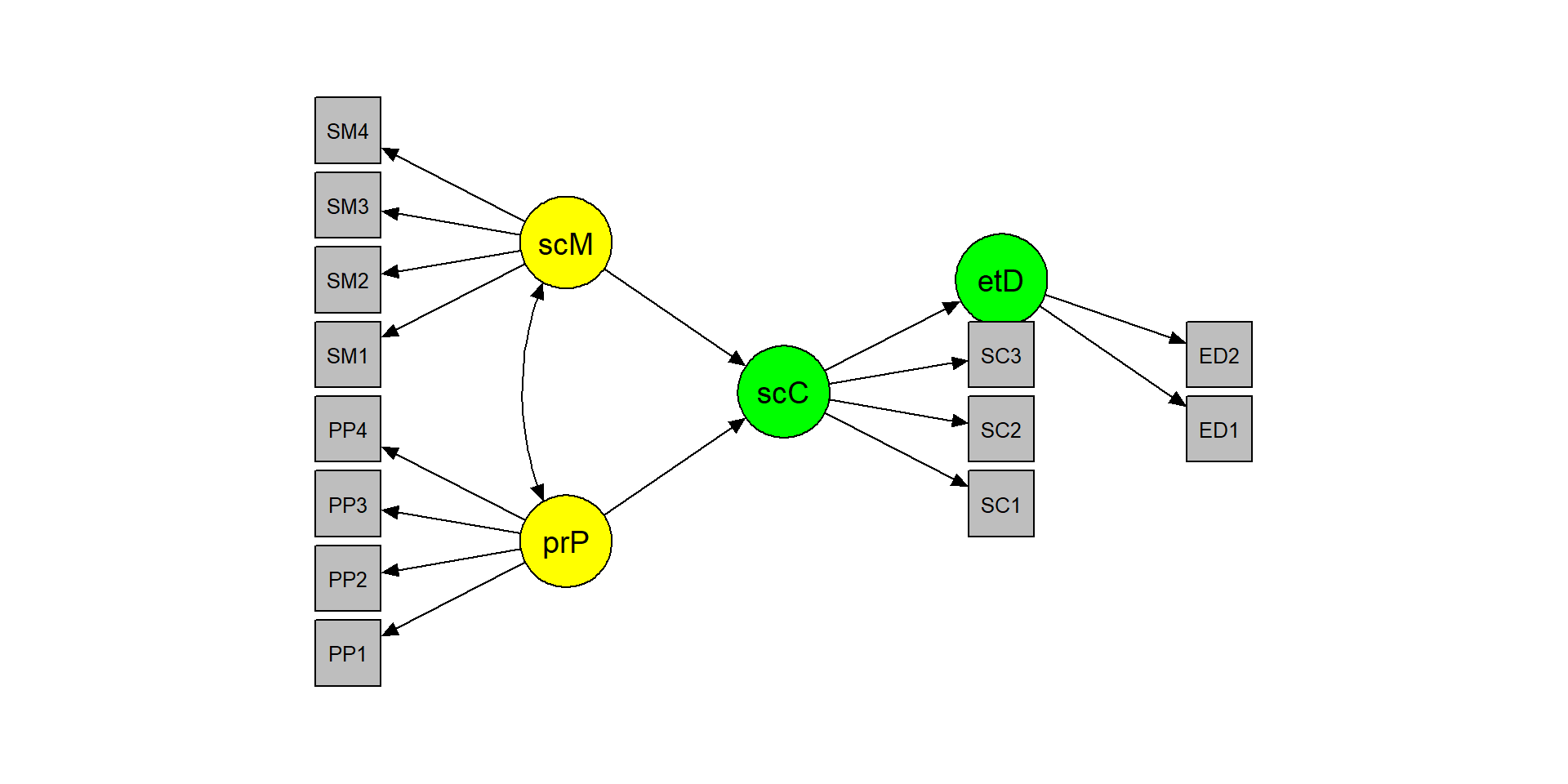
The exercise
- Apply the two-step rule:
- Test the CFA model
- Test the structural model
- Inspect model results and fit indices
- Are the hypotheses confirmed?
- Does the model fit the data well?
- If the model is not satisfactory, understand why and change it
- Draw the model (in
R, ppt, or with a pencil) - Try to fit a simple path model using sum scores instead of latent scores
Model specification
STEP 1 and 2
m1 <- "
 # CFA model
 peerPressure =~ PP1 + PP2 + PP3 + PP4
 socialMedia =~ SM1 + SM2 + SM3 + SM4
 socialComparison =~ SC1 + SC2 + SC3
 eatingDisorder =~ ED1 + ED2
"
fit1 <- sem(m1, data = dE4_1, std.lv=T)
fit1@Fit@converged
m2 <- "
 [...]
 # Structural model
 eatingDisorder ~ socialComparison
 socialComparison ~ peerPressure + socialMedia"
fit2 <- sem(m2, data = dE4_1, std.lv=T)
fit2@Fit@converged
OK?
Results and fit
[...]
Regressions:
                     Estimate  Std.Err  z-value  P(>|z|)   Std.lv  Std.all
  eatingDisorder ~
    socialComparsn      0.344    0.047    7.322    0.000    0.356    0.356
  socialComparison ~
    peerPressure        0.139    0.038    3.636    0.000    0.125    0.125
    socialMedia         0.455    0.049    9.221    0.000    0.411    0.411

[...]Model modification
                 lhs op rhs      mi    epc sepc.lv sepc.all sepc.nox
120              SM1 ~~ SC2 328.967  0.565   0.565    0.628    0.628
49       socialMedia =~ SC2  56.910  0.378   0.378    0.289    0.289
57  socialComparison =~ SM1  54.668  0.292   0.323    0.283    0.283
121              SM1 ~~ SC3  51.713 -0.235  -0.235   -0.231   -0.231
50       socialMedia =~ SC3  30.539 -0.277  -0.277   -0.206   -0.206
119              SM1 ~~ SC1  22.069 -0.151  -0.151   -0.154   -0.154
143              SC1 ~~ SC3  19.170  0.293   0.293    0.285    0.285
74               PP1 ~~ PP2  18.341  0.665   0.665    1.201    1.201
97               PP3 ~~ PP4  15.333  0.126   0.126    0.109    0.109
58 socialComparison =~ SM2 13.081 -0.146 -0.162 -0.137 -0.137 cfi tli srmr rmsea
0.995 0.994 0.023 0.013 Why sum scores can mislead (measurement error → attenuation)
If an observed score \((X)\) is a noisy measure of a latent variable, measurement error tends to attenuate associations.
A classic intuition (simple linear setting):
\[ \hat\beta_{\text{observed}} \approx \hat\beta_{\text{latent}} \times \rho_{xx} \]
where \((\rho_{xx})\) is reliability of \((X)\).
This is exactly why latent-variable SEM can change “structural” conclusions even when factor scores correlate highly with sum scores.
Sum scores
d2 <- data.frame(
  peerPressure = dE4_1$PP1 + dE4_1$PP2 + dE4_1$PP3 + dE4_1$PP4,
  socialMedia = dE4_1$SM1 + dE4_1$SM2 + dE4_1$SM3 + dE4_1$SM4,
  socialComparison = dE4_1$SC1 + dE4_1$SC2 + dE4_1$SC3,
  eatingDisorder = dE4_1$ED1 + dE4_1$ED2)
path <- "
eatingDisorder ~ socialComparison
socialComparison ~ peerPressure + socialMedia"
fitP <- sem(path, d2)
fitmeasures(fitP, fit.measures =
              c("cfi", "tli", "srmr", "rmsea"))
cfi tli srmr rmsea
0.978 0.946 0.019 0.037 The ground truth
# peer pressure AND social media -> social comparison -> eating disorder
mE4_1 <- "
 # CFA model
 peerPressure =~ .75*PP1 + .72*PP2 + .59*PP3 + .65*PP4
 socialMedia =~ .45*SM1 + .55*SM2 + .59*SM3 + .65*SM4
 socialComparison =~ .81*SC1 + .75*SC2 + .86*SC3
 eatingDisorder =~ .70*ED1 + .65*ED2

 # Structural model
 eatingDisorder ~ .37*socialComparison
 socialComparison ~ .23*peerPressure + .41*socialMedia

 # Misspecifications
 # within construct
 PP1 ~~ .43*PP2
 # between construct
 SM1 ~~ .53*SC2
"
Sum scores VS latent scores
However, the debate is still open:
Thinking twice about sum scores (McNeish & Wolf, 2020)
Thinking thrice about sum scores, and then some more about measurement and analysis (Widaman & Revelle, 2022)
Psychometric properties of sum scores and factor scores differ even when their correlation is 0.98: A response to Widaman and Revelle (McNeish, 2023)
Thinking About Sum Scores Yet Again, Maybe the Last Time, We Don’t Know, Oh No (Widaman & Revelle, 2024)
Or some more Schimmack:
- Schimmack vs Gelman 1 (https://replicationindex.com/2023/11/17/loken-and-gelman-are-still-wrong/)
- Schimmack vs Gelman 2 (https://replicationindex.com/2023/11/25/loken-and-gelmans-simulation-is-not-a-fair-comparison/)
Indicator indifference: a measurement question with structural consequences
- How much should our conclusions depend on the specific items we happened to include?
- How many indicators are enough to recover a latent relation with reasonable precision?
- Is it better to have more indicators, or fewer but stronger and more central indicators?
- What happens when indicators differ in loading strength, construct centrality, or contamination?
- If the structural path changes a lot when we swap reasonable indicators, are we estimating a robust latent relation — or an item-bound result?
See the extra module
Exercises (Lab 05)
Go to:
labs/labs/lab05_sem_capstone_eat.qmdlink
You will practice:
- Apply the Two-Step rule (identify/fit measurement first, then structure)
- Evaluate the model using fit indices + diagnostics (global + local)
- Use MI + EPC/SEPC to propose a theory-justified modification
- Compare a latent SEM vs a sum-score path model
Take-home: 3 things
- SEM is measurement + structure — structural paths do not rescue poor measurement
- Treat fit indices and diagnostics as routine checks (global + local), not as a one-time hurdle
- Comparing models is scientific: theory → constraints → estimation → evaluation → transparent revision
Acknowledgments
Thanks to Massimiliano Pastore for his slides!

References
McNeish, D. (2023). Psychometric properties of sum scores and factor scores differ even when their correlation is 0.98: A response to Widaman and Revelle. Behavior Research Methods, 55(8), 4269–4290. https://doi.org/10.3758/s13428-022-02016-x
McNeish, D., & Wolf, M. G. (2020). Thinking twice about sum scores. Behavior Research Methods, 52(6), 2287–2305. https://doi.org/10.3758/s13428-020-01398-0
Widaman, K. F., & Revelle, W. (2022). Thinking thrice about sum scores, and then some more about measurement and analysis. Behavior Research Methods. https://doi.org/10.3758/s13428-022-01849-w
Widaman, K. F., & Revelle, W. (2024). Thinking About Sum Scores Yet Again, Maybe the Last Time, We Don’t Know, Oh No . . .1: A Comment on McNeish (2023). Educational and Psychological Measurement, 84(4), 637–659. https://doi.org/10.1177/00131644231205310